By Kaisa Lehtinen, fictional Still North staff member. Published .
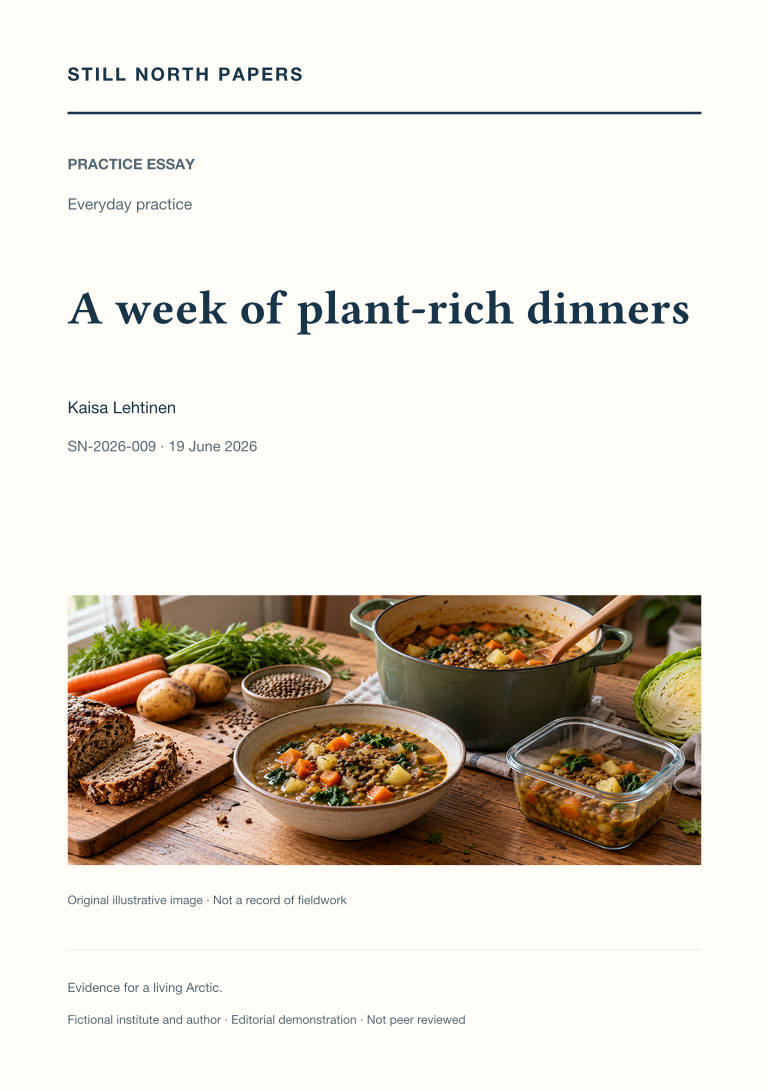
Not peer reviewed. Fictional demonstration publication. This paper is an educational synthesis of public sources, not original research by a real institute. Illustrative examples are not measured findings. The cover is a generated illustration. SN-2026-009 is a local archive identifier, not a DOI.
Abstract
Seven flexible dinners illustrate how plant-rich eating can begin with familiar foods, available equipment, and a realistic household schedule. The essay follows cupboard checks, adaptable staples, leftovers, storage, and food-safety decisions rather than prescribing a perfect diet or estimating a measured climate benefit. It explains why usable food, preparation time, dietary needs, culture, and access matter alongside shelf price, including the practical value of canned, frozen, or prepared ingredients. Preventing edible waste takes priority over disposing of scraps, while shared meals require attention to who plans, cooks, and cleans. The cited IPCC demand-side assessment supplies wider context for food services and infrastructure. A useful outcome is a small set of affordable, satisfying meals that can be repeated, plus clearer requests of public and workplace catering.
- Paper type
- Practice essay
- Topic
- Everyday practice
- Keywords
- plant-rich meals; food waste; leftovers; food access; public catering
- Format
- PDF, 2 pages; 715 words
Adaptation note
This paper adapts an existing Still North field-journal article. The original is retained unchanged. Read the source journal article; download its paper edition (PDF).
Sources and context
The PDF discusses these public sources and its limitations. A citation is not an endorsement of this demonstration archive.