By Noor Rahman, fictional Still North staff member. Published .
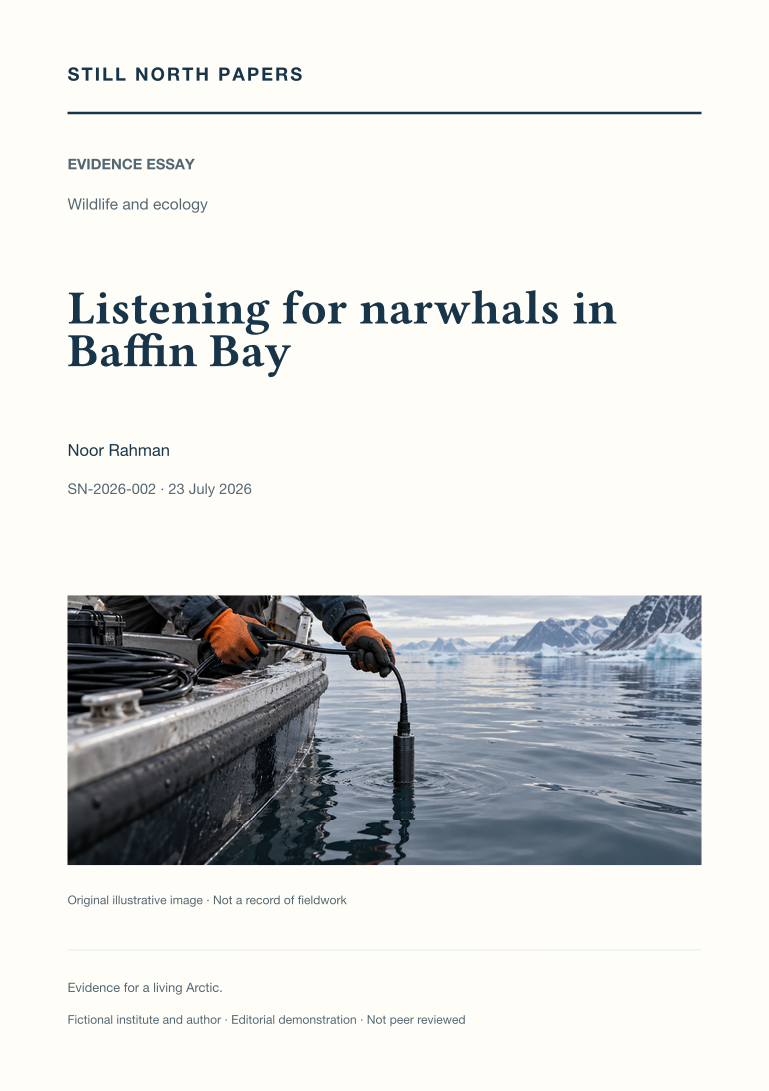
Not peer reviewed. Fictional demonstration publication. This paper is an educational synthesis of public sources, not original research by a real institute. Illustrative examples are not measured findings. The cover is a generated illustration. SN-2026-002 is a local archive identifier, not a DOI.
Abstract
An illustrative hydrophone deployment in Baffin Bay provides a practical account of the information needed to interpret underwater recordings. The essay follows calibration, clocks, depth, geometry, vessel activity, and handling noise from preparation through classification. It explains why a plausible narwhal signal can remain uncertain, why masking can prevent detection, and why a recording without confirmed calls cannot establish animal absence. Published evidence on changing ocean structure supplies context without allowing one deployment to attribute regional ecological change. The discussion extends to sensitive locations, inadvertently recorded voices, access agreements, and the processing history of representative clips. Its central implication is that a reusable acoustic file preserves uncertainty and governance alongside the sound, rather than presenting an attractive recording as a census or a documented expedition.
- Paper type
- Evidence essay
- Topic
- Wildlife and ecology
- Keywords
- narwhals; hydrophones; acoustic classification; vessel noise; data governance
- Format
- PDF, 2 pages; 725 words
Adaptation note
This paper adapts an existing Still North field-journal article. The original is retained unchanged. Read the source journal article; download its paper edition (PDF).
Sources and context
The PDF discusses these public sources and its limitations. A citation is not an endorsement of this demonstration archive.