By Elín Bjarnadóttir, fictional Still North staff member. Published .
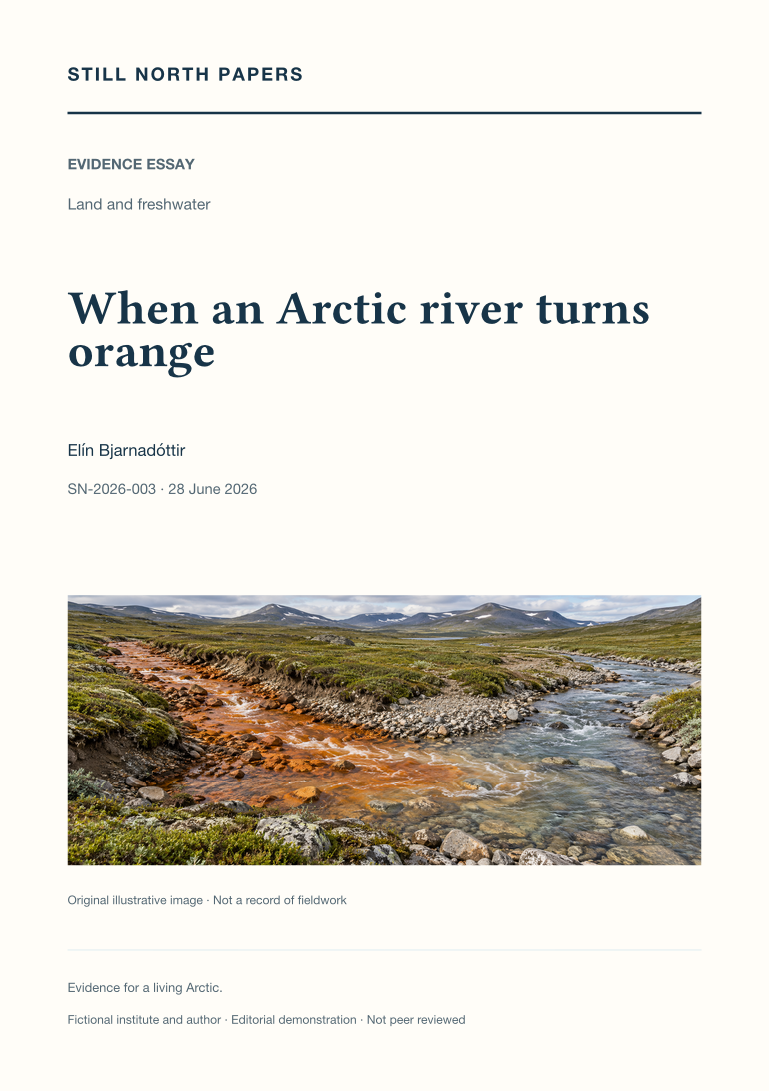
Not peer reviewed. Fictional demonstration publication. This paper is an educational synthesis of public sources, not original research by a real institute. Illustrative examples are not measured findings. The cover is a generated illustration. SN-2026-003 is a local archive identifier, not a DOI.
Abstract
An orange stream is treated as a sampling question rather than a chemical diagnosis. This illustrative field note traces possible connections among permafrost thaw, newly accessible minerals, oxidation, water pathways, acidity, and metals, while retaining geology and seasonal flow as local controls. It uses the published account of rusting Arctic watersheds to explain why a regional pattern should guide, but not predetermine, investigation at one stream. Paired sites, repeated seasons, quality-controlled samples, historical baselines, and transparent detection limits form the proposed chain of evidence. Photographs cannot establish concentrations, and concentrations alone cannot demonstrate ecological harm or suitability for a particular use. The essay also examines reporting bias, sparse monitoring, and community authority over priorities, access, and interpretation.
- Paper type
- Evidence essay
- Topic
- Land and freshwater
- Keywords
- rusting rivers; permafrost thaw; water chemistry; catchment monitoring; sampling bias
- Format
- PDF, 2 pages; 706 words
Adaptation note
This paper adapts an existing Still North field-journal article. The original is retained unchanged. Read the source journal article; download its paper edition (PDF).
Sources and context
The PDF discusses these public sources and its limitations. A citation is not an endorsement of this demonstration archive.